

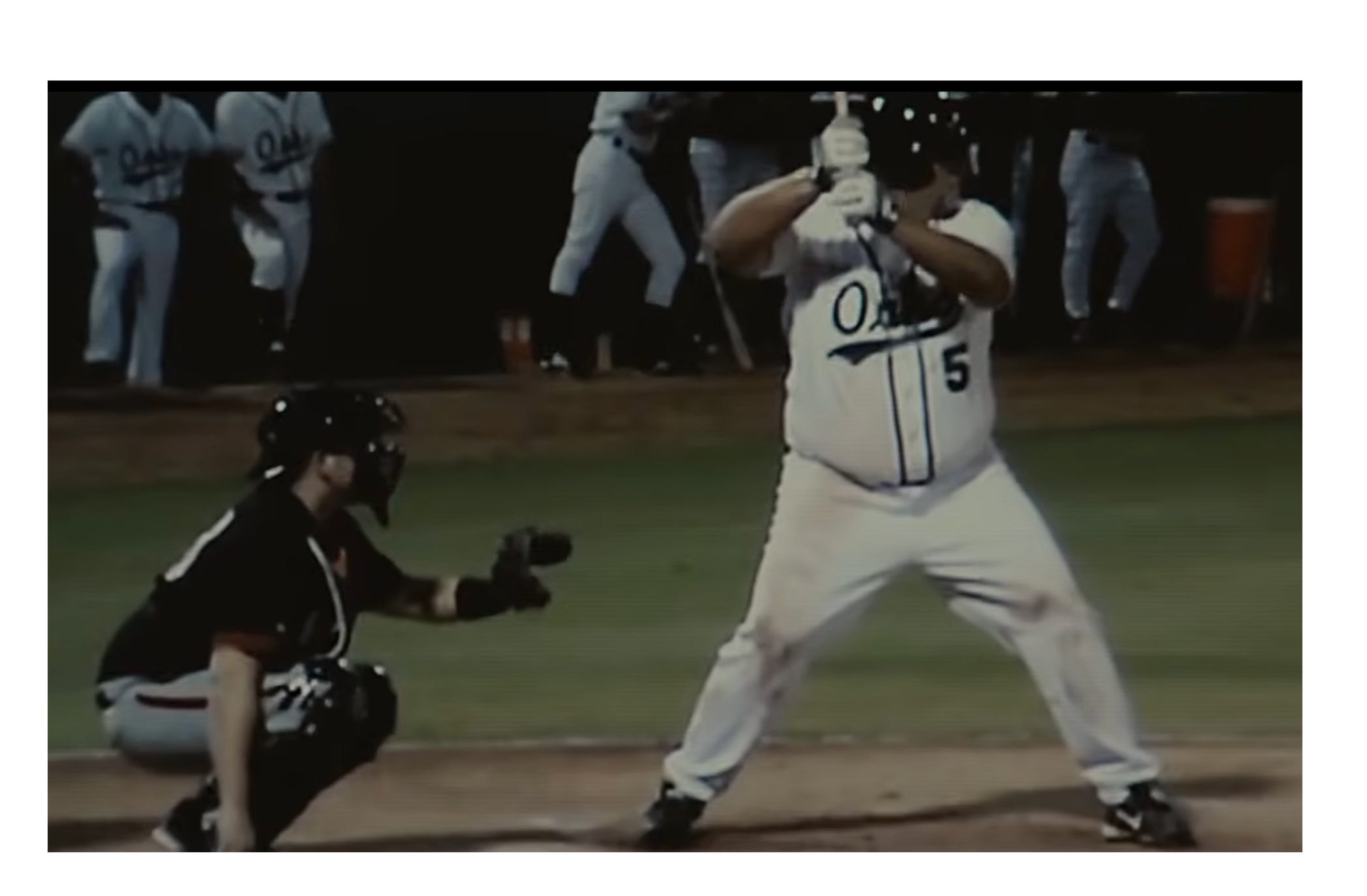
For those of us who did not grow up with baseball, the game arrived as a foreign language under impossibly blue skies with speakers who had decided that failure was interesting. A batsman who succeeded three times in ten was a hero. A game could proceed for hours while apparently nothing happened, except that everything happened; glances, hesitations, the adjustment of gloves, the slow accumulation of dread. Cricket I had been taught to understand as a childhood illness from which one never quite recovers. Baseball I encountered later, entirely through films, where it seemed less a sport than a system for arranging American faces against backdrops of stadiums and cornfields that always seemed to be shot in the golden hour.
Baseball movies are meant to be entertainment not propaganda but they work wonders on the foreign imagination with their arcane rules and lore and gorgeous settings and deep weirdness. There’s a famous piece of graffiti from the Iraq War that I remember well: “Yankee go home - and take me with you.” Baseball movies put this idea into one’s head and the really remarkable thing about them is that they rarely require you to understand baseball. They require only that you comprehend what David Hume pointed out in his Enquiry Concerning Human Understanding: reason is important, but reason is the slave of the passions.
The Bad News Bears (1976) is probably the first baseball film I saw or half saw on TV in the late 1970s. And it’s a good place to begin because it has the honesty to admit that childhood sport is not an idyll. Walter Matthau’s Morris Buttermaker is a booze addled wreck, yelling at little kids, drunk driving, lying and manipulating and complaining and yet we love him immediately and we love him more at the end of the film when he has an epiphany about what Little League Baseball is actually all about. The kids are wrecks too, uncool and mean and spouting the kind of racist and derogatory language that would make a Hollywood exec from our day have a fainting fit. And yet baseball works its magic, a team comes together, they fight against all odds and… Well if you know the ending you know the ending and if you don’t you should watch it.
With a poor grasp still of the rules the next baseball film I saw was The Natural (1984) which takes baseball and inflates it until the game becomes Arthurian legend with wooden bats. I’ve read Bernard Malamud’s novel on which the movie is based and that book is a taut, cynical masterpiece that bears almost no relation to the sentimental poetry of the film. Robert Redford’s Roy Hobbs is a stoic American icon who could be about to walk on the moon or plant a flag on Iwo Jima rather than hit a game winning home run with two outs in the bottom of the ninth. The Natural is not a subtle film but subtlety was never the point. The film understands the American appetite for the impossible comeback, the belief that destiny has been waiting patiently for us to stop wasting its time. I bet I wasn’t the only one who watched The Natural on home video in a drab damp council estate in Northern Ireland in the 1980s and thought I gotta get out of this place and across the sheugh.
The next baseball film I saw was probably Bull Durham, (1988) which suggests that baseball is partly an excuse for adults to remain adolescents while discussing metaphysics in locker rooms. Its great subject is not sport but the elaborate comedy of professionalism: the rituals by which people persuade themselves that repetition is wisdom. Major League (1989) has much of the same idea and tells a similar story in broader strokes. In Bull Durham Kevin Costner’s veteran catcher understands the game because he understands its absurdity, a qualification that ought to be required for participation in almost every human institution. The supporting cast here is excellent, particularly Tim Robbins and Susan Sarandon. Eight Men Out (1988) is the necessary corrective: baseball not as myth but as commerce, corruption and class resentment. The Black Sox scandal reminds us that nostalgia is often history with the difficult bits removed. The game is beautiful, but the people who own it need not be. A League of Their Own (1991) performs a similar rescue operation, returning women to a history from which popular memory had largely misplaced them. The famous “no crying in baseball scene” is funny because the joke conceals a serious proposition: that women, too, deserve the right to be ridiculous, ambitious, competitive and magnificent.
One of the oddest and most financially successful of all these baseball movies came out in this period too, the deeply sentimental Field of Dreams (1989) based on a wonderful WP Kinsella book, Shoeless Joe.1 Field of Dreams is the film most likely to reduce the cynical anti baseball snob to first rage, then silence, before he then mysteriously excuses himself and runs from the room with something happening to his eyes. Its premise is preposterous, which is why it works. Ray Kinsella (a never better Kevin Costner) hears a voice that tells him to plough over his cornfield and build a baseball diamond in the middle of the crop in the middle of frickin Iowa. He also has to find JD Salinger (renamed as Terry Mann and cast as James Earl Jones for the film) and bring him to the field. And he picks up some other people along the way just as his farm is going bankrupt. The plot is haphazard and to my money doesn’t quite work on paper but works perfectly on the screen. Baseball becomes the American dream, a bridge between generations, particularly fathers and sons. Field of Dreams is a kind of icky prose poem ahout the living and the dead, about loss and nostalgia and memory. This sounds like hokum. It is hokum. So why are you crying?
After growing up with all these baseball classics I had to sit through a lot of baseball duds before the next classic came along in 2011. By Moneyball, baseball has become a spreadsheet with grass around it. Numbers challenge romance, only to generate a new kind of romance: the romance of intelligence refusing to accept tradition’s invoice. Statistics, it turns out, can be as emotional as violins. Brad Pitt is Billy Beane, the general manager of the Oakland As who has to assemble a team under constrained financial circumstances. He meets Jonah Hill and they begin to follow the philosophy of baseball writer Bill James who used mathematics to figure out what really makes a valuable player. This is largely behind the scenes stuff but the baseball bits of this baseball movie, a mix of real footage and Hollywood footage are very well done. The script sings like it was written by Aaron Sorkin because it was written by Aaron Sorkin. The scene with Chris Pratt in his house at Christmas is an exemplar of fine screenwriting, acting, blocking and directing. To me it’s a funnier film than the ostensible comedies Major League and A League of Their Own. Its also got your bog standard baseball arc. In a good baseball movie the players and coaches grow and change and become better people. (Except in The Natural, of course, where Robert Redford is good, stays good, remains good but whose goodness infects everyone else). Here broken players (“an island of misfit toys” is how Sorkin memorably puts it) get second chances and this works because, of course, we all would love a second chance at something. If you know the history of the Oakland Athletics you’ll know that Moneyball did not bring Oakland a World Series, not then, not now. In fact the Oakland As are, sadly, no longer even in Oakland.
But winning isn’t actually the point of these films. Has never been the point. None of the movies I’ve mentioned here ends with the team actually winning the World Series. Bloody none of them. Remember what I said about failure? These films are about character growth, team work, the poetry and beauty of a baseball park under a late summer sky. “How can you not be romantic about baseball?” Brad Pitt asks in Moneyball. Perhaps that is why baseball films are so welcoming to outsiders. You need not know the infield fly rule. You need only recognise the deeper game: everyone gets another turn at bat, but not one of us knows how many it’s going to be. Savour the summer while you can because November is coming and all this sublime nonsense is, alas, going to end.
I’m no expert but here’s a couple of other baseball books I can recommend: The Boys of Summer, The Art of Fielding, Ball Four, Ladies and Gentlemen the Bronx is Burning, The Natural, Bang the Drum Slowly, Shoeless Joe, The Iowa Baseball Confederacy, Underworld
August 1991, I drove through the day and night with a friend to Dyersville, Iowa. No mobile phones or Waze - just maps and friendly locals who helped us find our way to the Field of Dreams, where we shagged flies and played ball on a perfect summer day. Some time in the mid-afternoon, 8 guys in 1919 White Sox uniforms emerged from the corn to join us. No announcement, no Insta, they were just there. Goosebumps even now as I think back.
I cried the first time I went to a Saint Paul Saints minor league game and the players walked out onto actual grass underneath an unshielded sky. It was just so beautiful.