
Razorback
a largely forgotten Ozploitation movie about a killer pig terrorizing the bush which is more beautiful than it has any right to be and which fired my early imagination

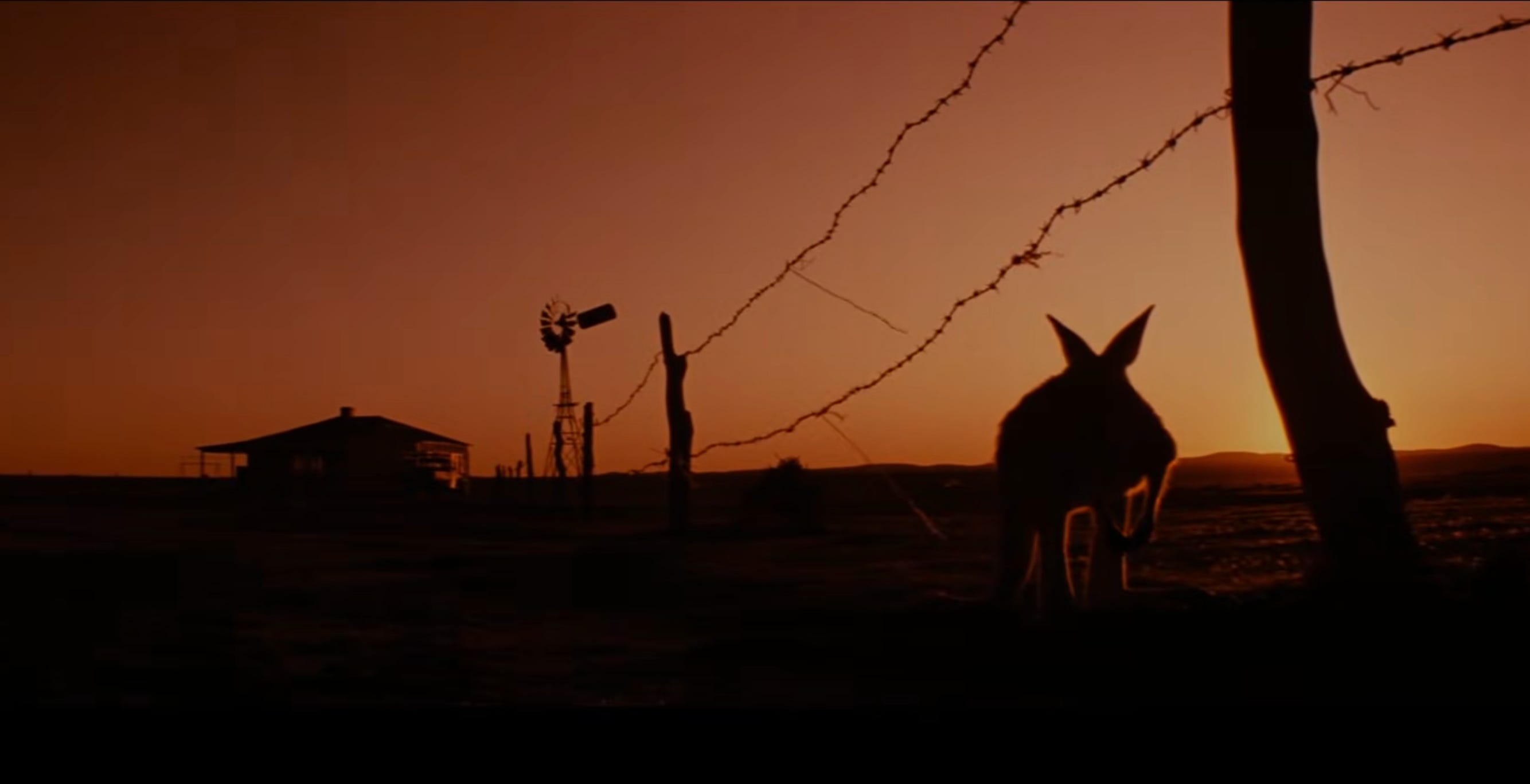
There is something wonderfully disproportionate about Razorback (1984). It is a film about a gigantic murderous pig, yet it was photographed as if the fate of Western civilisation depended on the correct exposure and imaging of the Australian outback. This was the great achievement of director Russell Mulcahy and cinematographer Dean Semler: they gave a homicidal boar movie considerably more visual dignity than the subject matter had any reasonable right to demand. The film won Semler the Australian Film Institute award for Best Cinematography, which is not surprising when you notice the meticulous framing and observe how many shots were laboriously set up for the pre dawn light or the golden hour. Can you imagine how hard it was to convince that crew on that pay to get up at 3 in the morning for one shot in a killer pig film? Give him all the awards.
Of course I saw Razorback on home video in the great era of video stores when the clever store owners had a Banned in the UK section or a Video Nasty section. Razorback was a video nasty but there’s really nothing nasty about it. It’s a largely good natured very cheap Jaws ripoff.
Jaws had demonstrated that audiences would pay to watch people being menaced by an animal, provided the animal was large, the victims numerous and the director knew when not to show the beast. Hollywood responded with the usual zoological parade: bears, alligators, orcas and anything else capable of having teeth or, failing that, an alarming number of tentacles. Australia, meanwhile, had its own exploitation tradition, which added kangaroo shooters, hostile locals, desert landscapes and the general suspicion that civilisation had stopped somewhere around the edge of Sydney.
Razorback takes the Jaws formula and drives it into the outback. The result ought to have been straightforwardly ridiculous. Instead, Mulcahy and Semler make the landscape itself seem diseased. Using widescreen Panavision photography, harsh light, deep shadows, dust, mist and surreal compositions, they turn the desert into something closer to a nightmare by Salvador Dalí than a location for a film about agricultural livestock.
Mulcahy had arrived from music videos, and he directs accordingly: images collide, editing moves briskly, and almost every shot seems to know that it could be printed on a poster. This occasionally makes the film feel as though the narrative has wandered into a particularly expensive pop video. Yet it is precisely this excess that saves Razorback. Even when the mechanical boar fails to convince, the filmmaking does. The full-sized creature famously malfunctioned and appears for only moments; Mulcahy and Semler simply photograph around the problem, using suggestion, shadows and fragments. In other words, they accidentally rediscover the lesson of Jaws: imagination is cheaper than machinery.
The career trajectories afterwards make the joke even better. Mulcahy went on to Highlander (1986), where his music-video instincts found an even larger playground. Semler, already celebrated for Mad Max 2, reunited with George Miller for Mad Max Beyond Thunderdome in 1985 and eventually photographed Dances with Wolves, for which he won the Oscar.
Blade Runner (1982) had opened up my young mind to the possibility that art could be found in the s/f and horror movies that I loved; films like Razorback and Mad Max 2 and Excalibur confirmed that beauty could co-exist with schlock. And I have now built an entire writing career on this formula.
So Razorback remains a curious triumph: a film whose subject is exploitation, whose budget is visibly being exploited before our eyes, whose actors are gamely over the top and whose cinematography refuses to cooperate with these tropes. The pig is ridiculous. The desert is magnificent. 1
it would be remiss of me to leave the topics of Australia and Pigs without mentioning the great Australian bush poet Les Murray who I met once at the Adelaide Writers Festival and who wrote this little masterpiece:
Pigs
Us all on sore cement was we.
Not warmed then with glares. Not glutting mush
under that pole the lightning’s tied to.
No farrow-shit in milk to make us randy.
Us back in cool god-shit. We ate crisp.
We nosed up good rank in the tunnelled bush.
Us all fuckers then. And Big, huh? Tusked
the balls-biting dog and gutsed him wet.
Us shoved down the soft cement of rivers.
Us snored the earth hollow, filled farrow, grunted.
Never stopped growing. We sloughed, we soughed
and balked no weird till the high ridgebacks was us
with weight-buried hooves. Or bristly, with milk.
Us never knowed like slitting nor hose-biff then.
Nor the terrible sheet-cutting screams up ahead.
The burnt water kicking. This gone-already feeling
here in no place with our heads on upside down.
Great review of a long overlooked “agricultural livestock” film! It’s a genre I’m inclined to be drawn to, (The Butcher Boy also comes to mind)!
Considering our current political climate, there seems to be parallels to the Ray-Gun era these days, with respect to our environment! If this film is a cinematic omen then perhaps history will repeat!
Having just returned from the magnificent Red Centre, I can't wait to track this down.